What if the environmental movement and policymakers were simultaneously underestimating the possible harm to nature from artificial intelligence, while also failing to fully harness its potential to advance the conservation of land, water, and wildlife? Based on the current disparate approaches that conservation organizations are taking, that seems to be the current state of play. But if we act quickly and align around a common, comprehensive AI agenda, we can change course. The incoming Congress, elected in part because of a national backlash against AI, offers an immediate pathway for major policy actions to strengthen protections for nature.
At the moment, United States conservation advocates are overwhelmingly focused on what I would call the “footprint” part of AI—the direct physical environmental impacts of the rapid buildout of huge data centers. Concerns about AI’s direct footprint are justified. The Environmental and Energy Study Institute chronicled the environmental impacts of data centers in a comprehensive series of reports. Data centers can upend power grids, cause pollution, use vast amounts of water, create health risks, and more. Local communities have raised increasing concerns, and now threats to public lands are rapidly emerging. The Trump Administration is easing permitting and encouraging the buildout of new data centers on federal lands across the country and even considering transferring public lands for data centers. Last month, a massive, 9,000-acre nuclear-powered data center was proposed on public lands near Price, Utah.
Opponents of poorly planned data centers have quickly built a powerful movement, attracting local, regional, and national advocates from across the political spectrum, and their rapid and effective organizing should be celebrated.
The incoming Congress, elected in part because of a national backlash against AI, offers an immediate pathway for major policy actions to strengthen protections for nature.
As disturbing as the environmental impacts of data centers are, however, a much larger threat has gone largely unaddressed: AI’s downstream impacts on nature. AI doesn’t simply consume resources. As a rapidly evolving general-purpose technology, it is also an economic accelerant for virtually all sectors of the global economy.
Massive Downstream Effects on Nature
Focus for a moment on how the AI economy works: AI optimizes for what it is paid to do. While the huge AI companies started out with promises of an AI-driven utopia (with cancer cured and economic abundance for all), they quickly moved from social-good initiatives to become some of the largest for-profit companies on the planet. In 2024 alone, private investors poured more than $250 billion into the AI sector, overwhelmingly driven by expectations of financial gain. This capital is being used to expand extractive industries, scale industrial agriculture, streamline resource logistics, and supercharge consumer demand—all of which are engines driving ongoing biodiversity loss. Consider that AI enables industrial fishing companies to better locate the hardest-to-catch fish, or helps the timber industry determine where environmental laws are weakest for logging across the globe.
AI enters into the equation in a world already facing a biodiversity crisis, with up to a million species facing extinction, many within decades, primarily driven by land-use change and overexploitation of the ocean. With the natural world already facing major stress (much of it generated by resource extraction and consumption that destroy habitat), AI developers are promising to step on the accelerator. Anthropic’s internal models, for instance, forecast that AI could increase U.S. economic output by almost 50 percent by 2030.
Conservation groups have historically used the time between when a new threat is proposed and when it is implemented to organize, advocate, and regulate. But we have never seen anything like the speed of the change AI is bringing, with dramatically shortened periods to react to radical shifts in the economy that may overwhelm our ability to address threats on an industry-by-industry basis.
Some have dismissed concerns of AI-driven nature loss, claiming that AI-enabled efficiency will reduce environmental impact, but economists have shown that often the opposite is true, via what is known as the ”rebound effect”—whereby efficiency can result in more overall use and consumption, not less. And despite AI companies’ lofty mission statements about AI’s potential to improve environmental outcomes, shareholder returns and profit are the primary objectives. Companies won’t prioritize the environment unless it is in full alignment with their profit motives.
AI should not be fully unleashed onto the world economy without understanding the extent of its impact on the environmental systems that sustain all life on Earth.
Major new research is needed rapidly to truly understand these downstream impacts AI could inflict on nature. The climate community has just begun to grapple with the downstream impacts of AI on climate, including examining rebound effects of AI-driven efficiency gains. But similar research, and advocacy, has been entirely lacking for biodiversity and nature. The “precautionary principle”—proving the safety of a new technology or policy before deploying it—is warranted here. AI should not be fully unleashed onto the world economy without understanding the extent of its impact on the environmental systems that sustain all life on Earth.
Given these potentially huge impacts, nature safeguards should be embedded in all internal and external AI governance. Unfortunately, that is not currently the case. A review of AI charters, constitutions, and internal governance documents finds some serious concerns about the harm that AI can cause to humanity and to the economy. There are detailed internal restraints and rules, for instance, preventing building bioweapons, harming children, undermining democracy, or promoting misinformation or bias. These threats to human society are considered “first-tier” concerns by AI companies for their internal AI governance. But no such tier-one guardrails exist for AI’s impacts on the other millions of species, and their habitat. The AI Company Data Initiative found a shocking 97 percent of companies failed to consider the environmental impacts of their AI systems, despite their often-professed commitments to sustainability.
A similar situation exists in the public arena. President Biden’s Executive Order on AI governance—which President Trump revoked—didn’t include any nature safeguards, and the Trump administration has actively sought to prevent AI regulation, environmental or otherwise. Internationally, the UN hosted the first ever Global Dialogue on AI Governance in Geneva this year, but downstream nature impacts were fully absent from the main agenda. Meanwhile, most public proposals for enhancing AI governance, even those from the environmental community, fail to consider or include downstream impacts.
Should AI companies be responsible for the downstream impacts of AI-fueled economic growth? Absolutely. These companies have recognized their downstream responsibility when it comes to job loss, with CEOs publicly calling for universal basic income, but they have remained silent about responsibility for their systemwide impact on nature.
The Flip Side: AI for Good
Many in the conservation community have embraced AI and sought to put it to work to advance their missions. From updating their websites or taking notes during meetings, to analyzing long government documents, researching potential donors, or performing administrative tasks, AI has proven useful for many aspects of the work of conservation organizations. More importantly, conservationists have used the technology directly on programmatic work, such as identifying species, monitoring land use changes or forest cover, and prioritizing areas for conservation or restoration.
In February 2025, a number of conservation scientists teamed up with AI experts to scan the horizon for ways the technology could be used to advance conservation, and published their paper in Trends in Ecology and Evolution. They found major uses for AI in recognizing species, improving biodiversity loss predictions, monitoring wildlife trade, and addressing human-wildlife conflict. Tech companies have showcased and promoted the positive uses of AI for conservation, including Microsoft’s AI for Good Lab and Google’s Sustainability AI. The Bezos Earth Fund has launched a grantmaking window for AI use for climate and nature. And there is even a Coalition for Sustainable AI, which seeks to make “artificial intelligence beneficial to our environmental agenda.”
While all of these tools can be genuinely useful, we are collectively missing another potentially bigger opportunity: securing durable large-scale conservation funding from the AI companies and their charitable foundations.
Legislative proposals are emerging to require AI companies to pay for the harm they are doing to jobs. It's time for them to pay for harm to the natural world as well.
It's no secret that environmental endeavors—protecting habitat, raising awareness, restoring degraded areas, enforcing regulations—are chronically underfunded. Global funding for the protection of nature and biodiversity faces a shortfall of more than $1 trillion annually.
In the previous century, visionaries advocated for and secured two major federal funding streams for conservation: the 1937 Pittman-Robertson Wildlife Restoration Act, which provides hundreds of millions of dollars annually to state wildlife agencies via an excise tax on firearms and ammunition, and the 1964 Land and Water Conservation Fund (LWCF), which raises funding from offshore oil and gas receipts. We’ve had more than 50 years to understand just how beneficial these dedicated funding streams are for nature conservation, and yet for some reason there hasn’t been a comprehensive effort to create a new dedicated funding stream in decades. A fee on AI presents a major new opportunity.
AI companies were initially founded to solve big global challenges and serve the public good. They are also unique in that they touch virtually all sectors of society and have a clear environmental impact. Legislative proposals are emerging to require AI companies to pay for the harm they are doing to jobs. It's time for them to pay for harm to the natural world as well.
Global spending on AI is estimated to reach $2.7 trillion in 2026, meaning a one percent fee could generate $27 billion per year. That’s nearly double what the world’s wealthiest countries are spending on conservation in developing countries. Domestically, the LWCF and Pittman-Robertson deliver approximately $2 billion annually for nature conservation. The new Congress should prioritize legislation establishing a one percent conservation fee on all AI sales, which could measurably move the needle in protecting the natural assets that AI development threatens to harm.
While working to secure a mandatory fee on AI, there is another potentially massive source of funding for conservation: philanthropy from recently enriched AI founders and senior employees. Recent articles in Axios, the Washington Post, The New York Times, and other news outlets have shown that many AI executives are poised to become major donors and “transform philanthropy.” Indeed, Anthropic’s CEO and other senior executives pledged to give away 80 percent of their wealth. Some have stated that we are on the verge of a “third wave of philanthropy.” Tens of billions of new philanthropic dollars could soon become available to help fund the work of major conservation organizations seeking to protect the world’s lands, waters, and wildlife.
We are at a watershed moment, where AI—and its abundant funds—can either cause profound damage to nature and biodiversity, or be harnessed in the fight to protect it. How do we ensure that we prevent the worst harms and make the most of AI’s potential? My simple answers: Think big, and work together.
Now is the Time to Think Big
Addressing Congress in 1862, in the depths of the Civil War, Abraham Lincoln said, “The dogmas of the quiet past are inadequate for the stormy present. The occasion is piled high with difficulty, and we must rise with the occasion. As our case is new, so we must think anew, and act anew.”
It’s fitting advice for today. AI presents a challenge to, and an opportunity for, conservation unlike any we have seen in generations, if ever. It will require us to confront the opportunity and challenge in new ways. We won’t be successful if we only tackle one part of the challenge (data centers), or only utilize a small portion of the potential benefits of AI. Now is the time to think strategically. The new Congress offers a major, immediate opportunity.
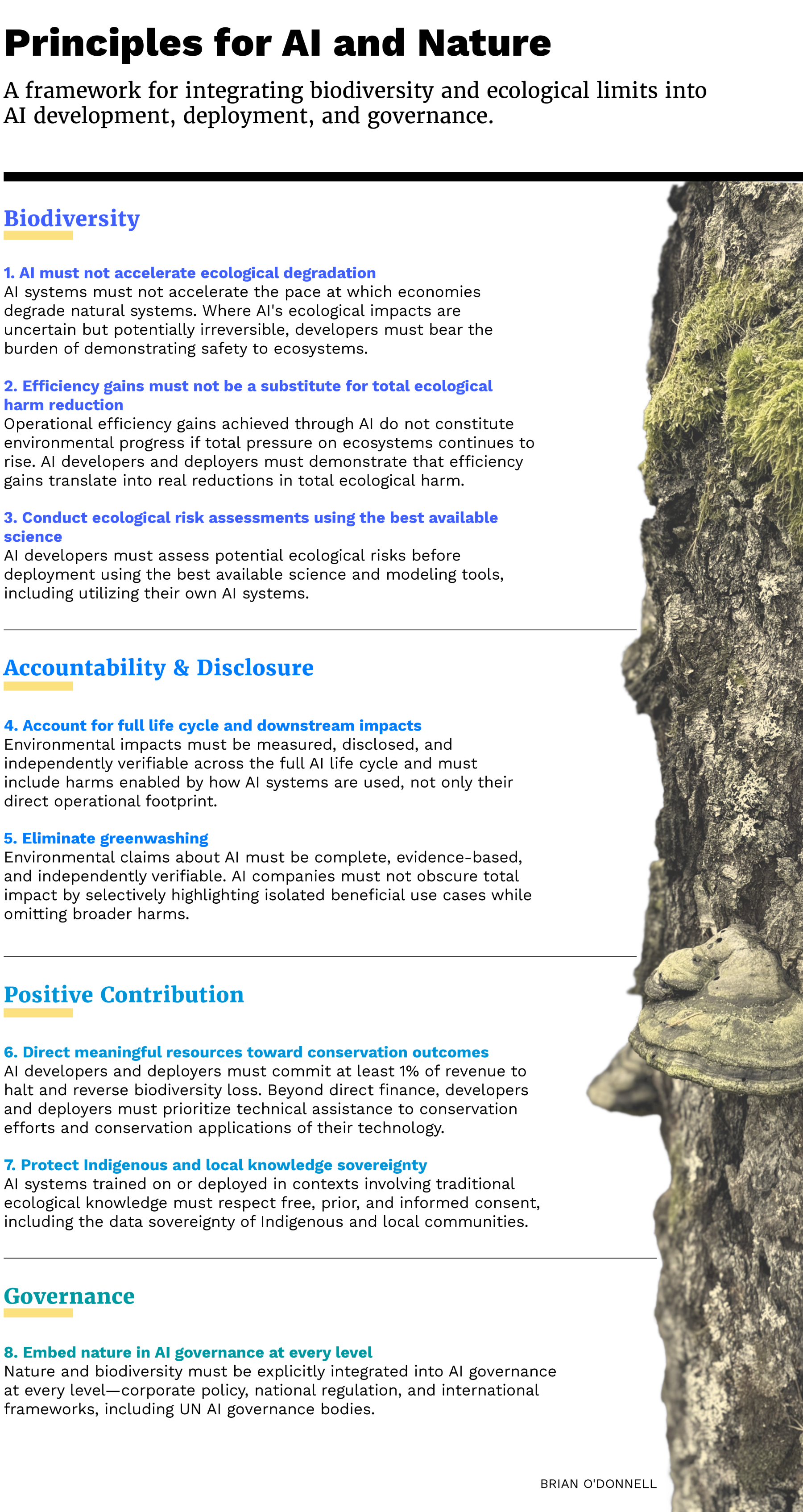
A key first step is development of a comprehensive Nature-Positive AI strategy formed around a set of principles that can be utilized at the global, national, and local level. (See “Principles for AI and Nature,” below.)
But to be effective, these principles should be refined and improved in the larger community of environmental, Indigenous, scientific, and government leaders. Time is short, and we need to move at the pace of change or risk being left behind. The key is for the principles to address all aspects of AI’s relationship with nature, with a focus on AI governance. Biodiversity loss needs to be a first-tier AI governance priority. Once principles are agreed to by a critical mass of environmental leaders, an implementation strategy needs to be developed and adequately prioritized and funded. We should be thinking on the scale of advocacy that brought us the Clean Water Act, the Alaska Lands Act, or the National Environmental Policy Act. This should not be a sideshow in the conservation agenda. It needs to move toward center stage.
We Must Work Together To Confront the Challenges and Benefits of AI
Taking on this agenda will require cooperation and a common agenda between environmental and Indigenous leaders, government champions, and concerned economists and scientists. While individual community campaigns to require adequate safeguards for, or outright opposition to, data centers will remain important, they should be part of a more comprehensive AI strategy. If our community is fragmented between those fighting individual data centers and those utilizing AI for discreet conservation objectives, we are doomed to failure at the larger scale.
We should be thinking on the scale of advocacy that brought us the Clean Water Act, the Alaska Lands Act, or the National Environmental Policy Act.
This is not a moment for a fundraising free-for-all, where organizations see AI philanthropy as a chance to fund pet programs. We should be uniting around a common message and campaigning to get AI philanthropy fully into the conservation agenda at large. That means cooperative fundraising in a manner that is a departure from the competitive approach too often taken by NGOs today. We need to collectively make the case to this new crop of AI philanthropists about why they should support a nature agenda, and that we have a solid, collective plan to achieve progress at a scale commensurate with the biodiversity crisis, both at home and around the globe.
We are embarking on a new era. Let’s lift our heads up and ensure that we shape how AI impacts nature, before it's too late.